



I read 5,786 CLAUDE.md files to see if Boris Cherny was right
Fred Chang ·
Our own CLAUDE.md grew to 994 lines.
Boris Cherny, who built Claude Code, would delete it. On Y Combinator's Light Cone podcast he said to start over and add a line back only when the model goes off track: "What you're probably gonna find is with every model, you have to add less and less." His team's shared file is "pretty short," about a couple thousand tokens, and gains a line when a teammate's PR makes a mistake the file could have prevented. At YC Startup School he described re-testing the same way: his team deleted Claude Code's system prompt and brought it back line by line, cutting over 80% of it for Opus 5. His advice: "every six months, delete your CLAUDE.md, delete your skills, delete your hooks," and add something back "only when you see it repeatedly stumble on the same thing."
So what did Boris keep? The team file he described is in Anthropic's private code. The one in the public anthropics/claude-code repo, which holds Claude Code's issues and plugins, is 40 lines. Every line is a boundary: the runner, network allow list and permission mode that any workflow calling Claude must keep. A CI check fails a workflow that breaks one.
What does everyone else keep as models improve? I read 5,786 CLAUDE.md and AGENTS.md files from GitHub to find out.
TLDR: new files got a third shorter. People cut rules about how to write code and kept rules about what the agent must not touch.
What people cut from CLAUDE.md files, and what they kept
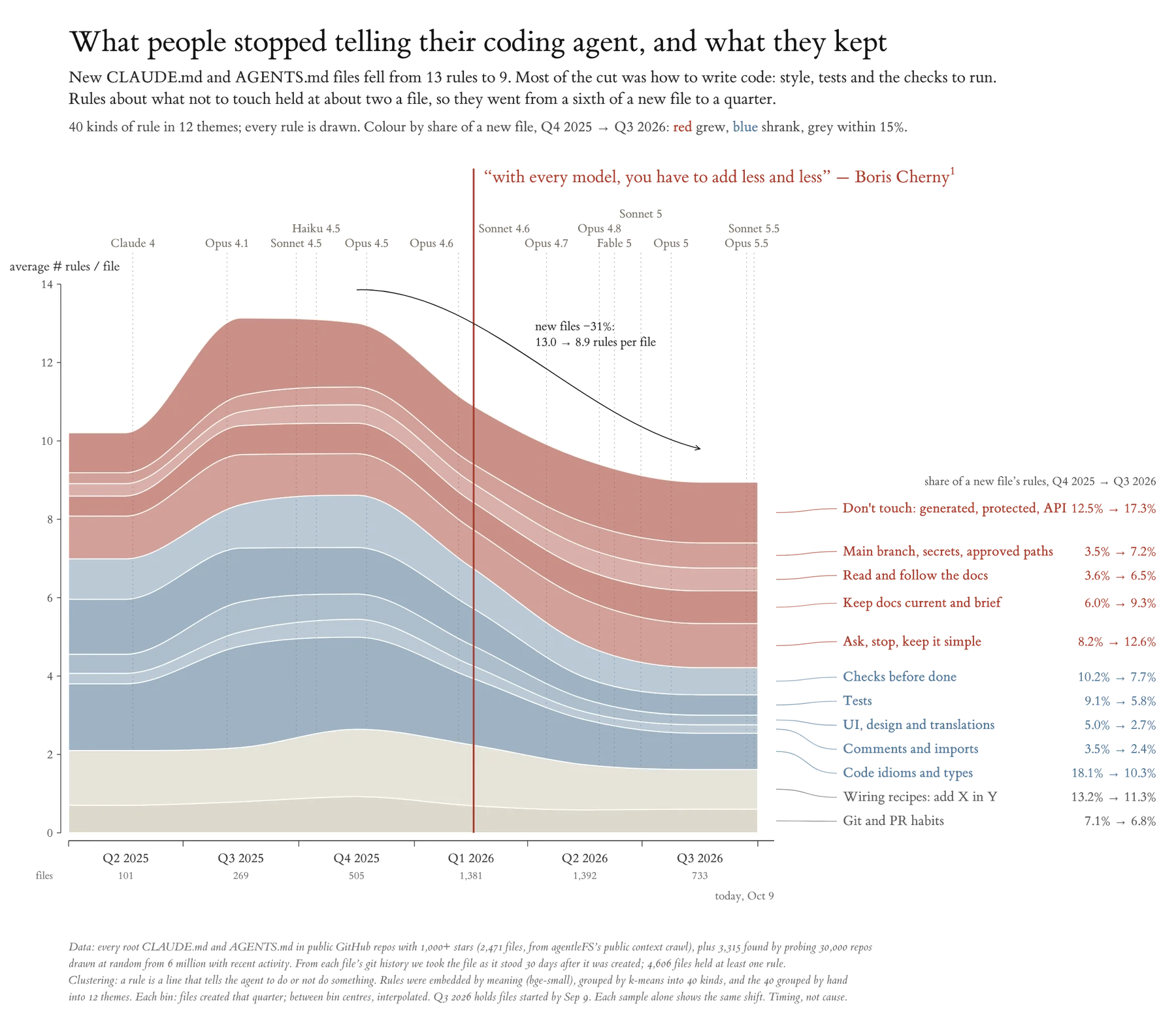
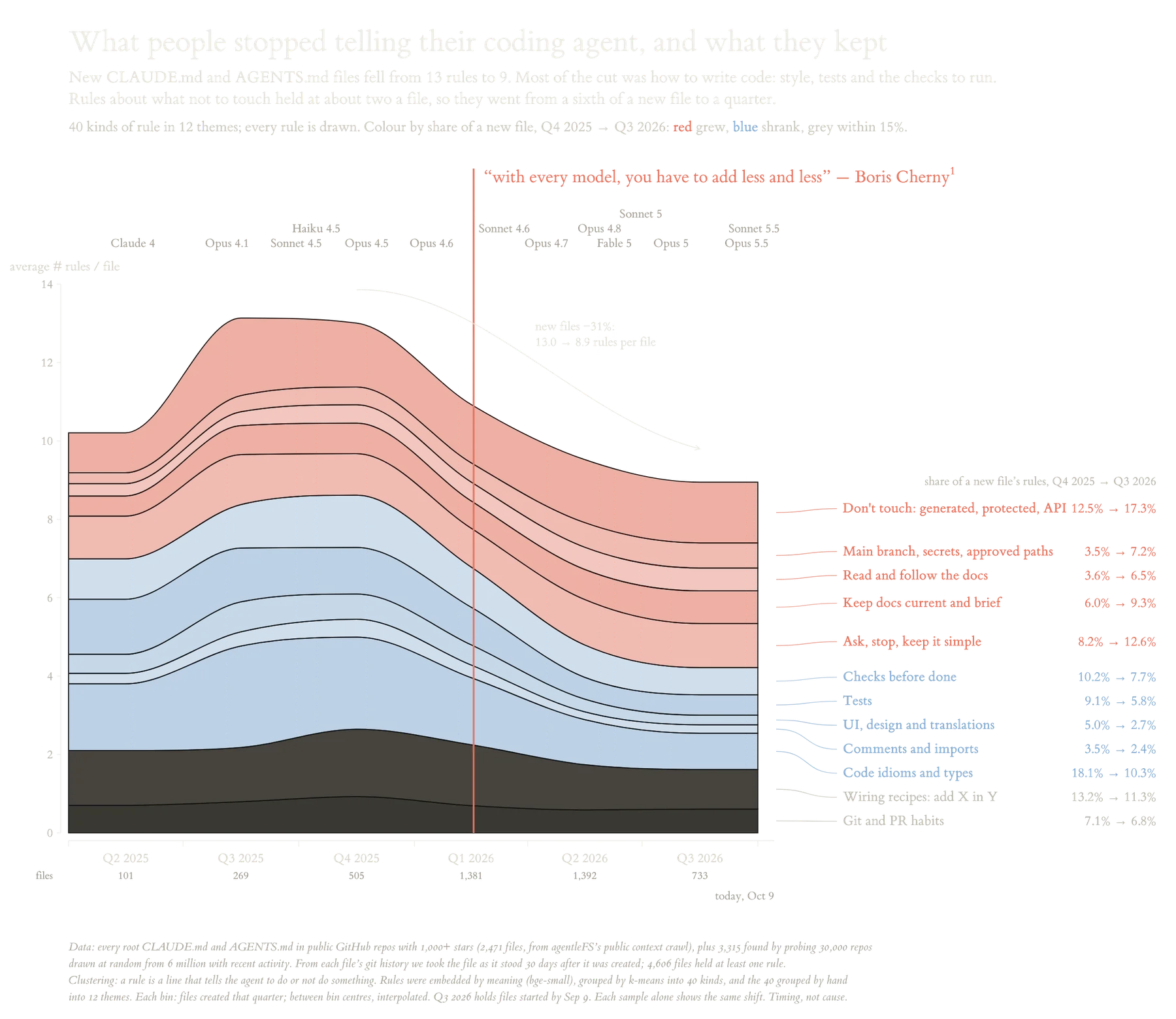
Coding advice (style, tests, checks before done) fell by about half per file. Rules about what not to touch held at 1.6 per file, and rules about the main branch and secrets grew. A model can learn your style from your code; it can't learn which files are generated or where the secrets live.
Does a CLAUDE.md file actually help?
At ETH Zurich, Thibaud Gloaguen and colleagues ran coding agents on real repository tasks with and without a context file, across several models and agents. The file "does not generally improve task success rates" and raised the cost by over 20% on average; its length made no clear difference. What helped was instructions for "non-standard coding practices," the conventions an agent can't get from your README. Repository overviews didn't help.
CLAUDE.md vs AGENTS.md: which should you use?
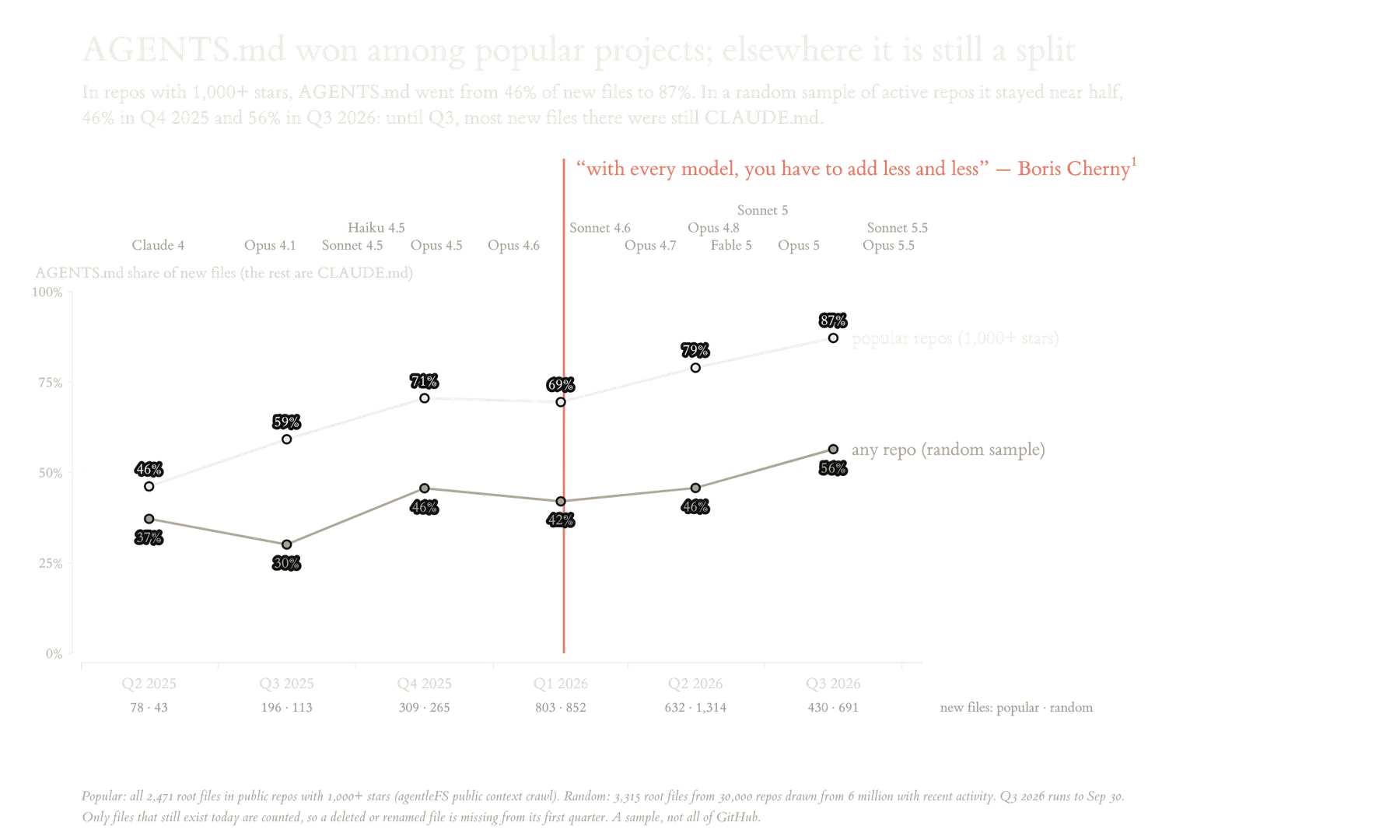
In repos with 1,000+ stars, 87% of new files are now AGENTS.md.
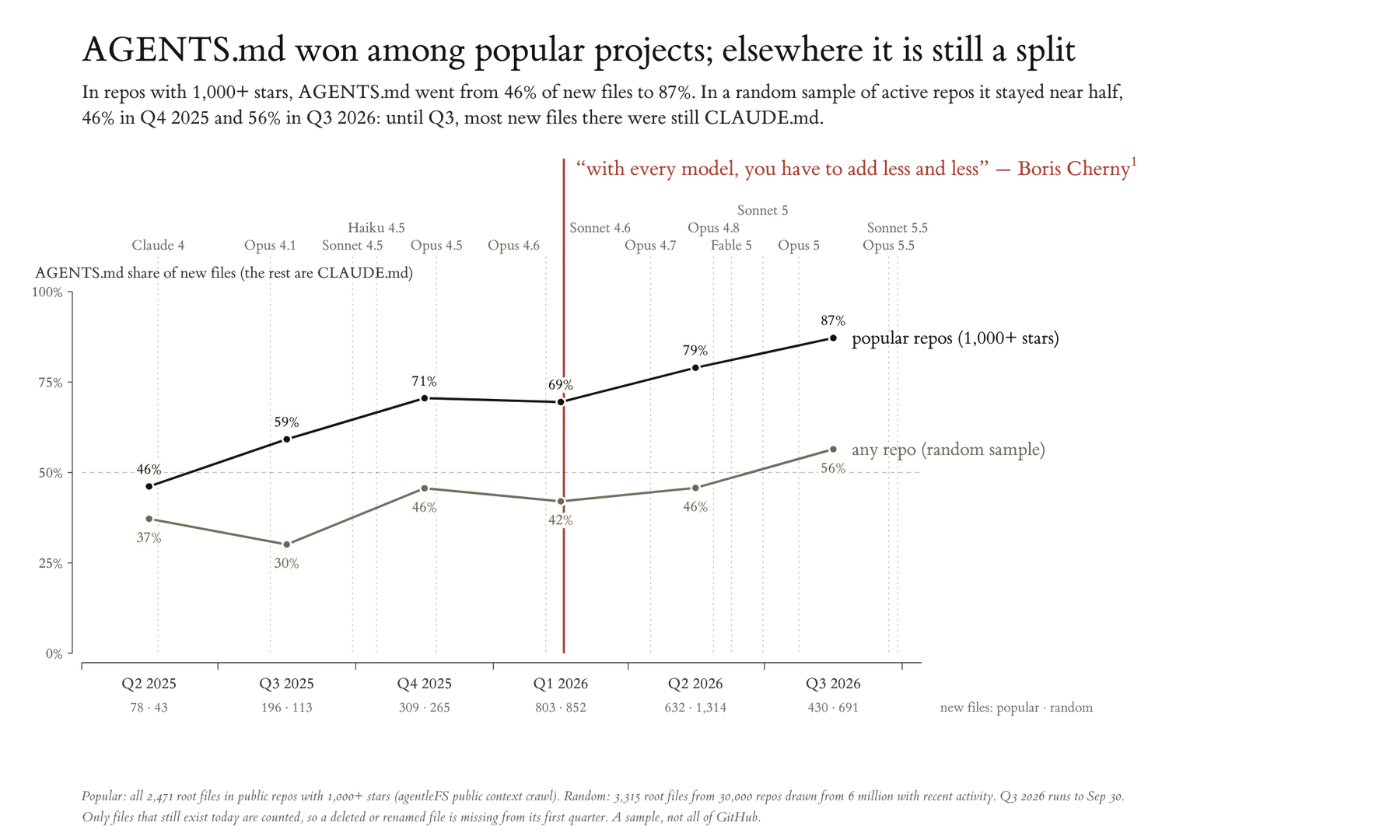
Make AGENTS.md your default. Codex, Gemini CLI, Jules, GitHub Copilot and Cursor read it, and Claude Code reads it when there is no CLAUDE.md (2.1.277 and later).
What's the most copied CLAUDE.md rule?
"No abstractions for single-use code," from forrestchang/andrej-karpathy-skills, a CLAUDE.md written from Andrej Karpathy's notes on LLMs coding badly.
What should go in your CLAUDE.md?
Cut:
- Style advice and repository overviews. The agent reads both from your code.
Keep:
- Boundaries: generated files, protected branches, secrets, public APIs.
- Conventions that differ from the defaults.
Enforce:
- Any rule that must never be broken, with a hook or a permission setting. The model reads the file; nothing makes it obey. Boris's team pairs its public file with exactly that kind of check.
Anthropic says the same: "Unlike CLAUDE.md instructions which are advisory, hooks are deterministic and guarantee the action happens." Their best practices add that if Claude already does something right without the instruction, "delete it or convert it to a hook."
To check yours, run /doctor prompt-audit (Claude Code 2.1.283 and later). It flags instructions written for older models, references to files or commands that no longer exist, and contradictions, and changes nothing until you approve its edits.
Run this analysis yourself with agent skills
I ran it with four skills we published. They work in any agent that reads skills:
- github-file-historyevery version of any file across public GitHub repos.
- text-rule-trendshow the rules in versioned text files change over time.
- tufte-chartsclean, directly labelled charts that read in light and dark mode.
- watercolor-data-artthe picture at the top of this post, painted from the data.
We turn anything we do twice into a skill and update it as models improve.
All 5,786 files are in our public catalog of CLAUDE.md examples and AGENTS.md examples. That catalog is the public half of agentleFS. The private half holds your team's own CLAUDE.md, AGENTS.md, skills and docs, shared with your agents under your permissions. Connect an agent, and it can search both.
- 1. "Inside Claude Code With Its Creator Boris Cherny", The Light Cone, Y Combinator, February 17, 2026.
- 2. Boris Cherny with Diana Hu, YC Startup School 2026, published July 27, 2026.
- 3. Gloaguen et al., "Evaluating AGENTS.md: Are Repository-Level Context Files Helpful for Coding Agents?", ETH Zurich, arXiv 2602.11988, revised September 29, 2026.
- 4. Anthropic, "Store instructions and memories (CLAUDE.md files)", Claude Code docs.
- 5. Anthropic, "Best practices for Claude Code", Claude Code docs.
- 6. anthropics/claude-code, CLAUDE.md, added September 25, 2026.
Appendix: how I did it
- 2,471 CLAUDE.md and AGENTS.md files at the root of public GitHub repos with 1,000+ stars, from our public catalog. The catalog keeps files over 1,500 bytes under licences that allow sharing.
- 3,315 more from 30,000 repos picked at random from the 6 million with recent activity, at any number of stars and any size. This sample checks the first one.
- Each file as it looked 30 days after it was created, so I'm measuring how people start a file, not how it grew. 4,606 of the 5,786 files had at least one rule.
A rule is any line that tells the agent to do or not do something. There were 96,576 of them. I grouped them by meaning into 40 kinds, then by hand into 12 themes.